Decline and Fall?
Making judgments about the decline of other societies is tricky business.


In a few weeks I will be traveling back to Europe to teach a short course in International Trade, as I have done for the past ten years. The trip will afford me a great opportunity to observe firsthand a society struggling with economic decline and civilizational erasure. At least that’s what I am to believe based upon the new National Security Strategy released by the White House on December 4. Right there on pages 25 and 26 we read:
“Continental Europe has been losing share of global GDP – down from 25 percent in 1990 to 14 percent today … But this economic decline is eclipsed by the real and more stark prospect of civilizational erasure … Should present trends continue, the continent will be unrecognizable in 20 years or less. As such, it is far from obvious whether certain European countries will have economies and militaries strong enough to remain reliable allies.”
I presume the irony of that last sentence was unintentional. It flows naturally out of a torrent of words about American economic prowess and European stagnation. Such thoughts merely express an extreme version of a narrative that has been gaining market share in geopolitical circles for years. In some cases, this narrative is taken as historical fact. It seems to be the premise of Oxford historian Anton Jäger’s recent New York times op-ed, in which he argues that Europe should just accept facts and settle down to the task of managing a graceful decline:
“… a reckoning with European decline – cultural, political and, above all, economic – could give rise to a healthily modest approach to the present. After a century in which Europe was in charge, with highly ambiguous results, it might even free Europeans of the burdening neurosis of mastery.”
The White House document uses a common metric, Share of Global GDP, to gauge the economic relevance (and vitality) of a country or region and to document what they claim is Europe’s economic decline. By that measure, Europe has indeed been losing ground, having generated 28% of global GDP in 1990 but only 18% in 2024 (these World Bank figures don’t quite match those used in the National Security Strategy document):
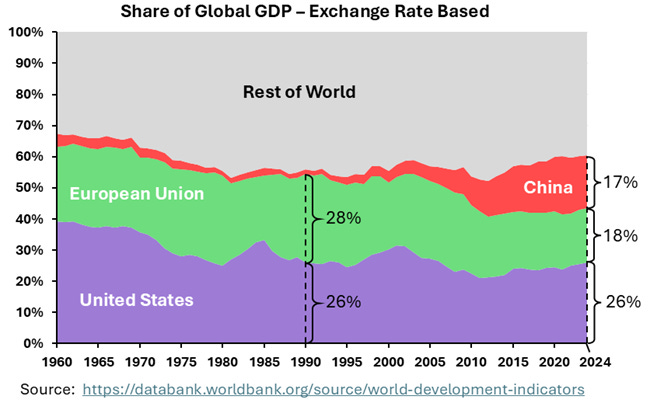
Cross-country comparisons such as these are tricky. To compare across countries, the various GDP amounts, originally valued in a country’s own currency, must be converted into a common currency. An easy way to do this is with prevailing exchange rates, which is exactly how the data used to create the chart above was generated. To make the comparison, Chinese and European GDP was first converted into dollars at prevailing exchange rates.
Exchange rates are fickle things though – they can distort actual purchasing power comparisons and thereby distort perceptions about actual economic size. For example, a Big Mac costs more than $6 in New York, while the current Yuan/Dollar exchange rate is approximately 7 (¥7 to $1), so you might expect a Big Mac in Shanghai to cost ¥42. But it actually costs about ¥28. It turns out that a Yuan in Shanghai has greater purchasing power than a dollar in New York. This has implications for comparisons made by merely converting values at prevailing exchange rates. The Economist’s Big Mac Index presents an amusing annual update of this method for evaluating the distortionary effects of exchange rates on actual purchasing power.
For this reason, economists like to use a method called Purchasing Power Parity (PPP) to make transnational comparisons. Such PPP-based comparisons factor in differences in domestic price levels. When we look at the share of global GDP using PPP-based comparisons, we get a different picture of the changing relative size of the major economies in the world:
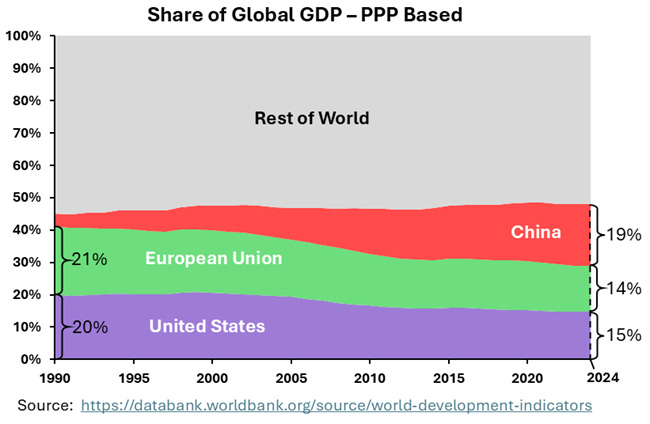
Two things stick out about the share of global GDP in this chart. First, Europe has still become relatively less important in the last 34 years, but so has the United States. The reason is obvious, and it has little to do with the economic decline of either the U.S. or Europe: the growth of China has given rise, in a fairly short period of time, to a third major economic power in the world.
Secondly, China’s share of global GDP, when measured in this manner, is larger than either Europe or the United States. This is why economists often point out that China’s economy, in terms of local purchasing power, is already larger than the American economy.
The lesson, as French economist Gabriel Zucman recently pointed out is that “Once adjusted for differences in price levels, there is no American miracle, any more than there is European stagnation.” In his essay, “Le mythe du décrochage européen” (“The myth of European decline”), Zucman takes on the “economic decline and civilizational erasure” narrative. He dismisses the notion of decline and focuses instead on positive features of the European economic model:
“… all these measures, which are limited to measuring the production of material goods and services, suffer from a far too restrictive perspective … Europeans benefit from more free time than Americans, a higher life expectancy, and lower levels of inequality – all with roughly comparable productivity … However you look at it, this is a clearly superior economic performance.”
His essay discusses another fact that will surprise most Americans: when we look at data on productivity, it turns out that Europeans are just as productive as Americans. In fact, until recently, German and French workers were more productive than American workers:
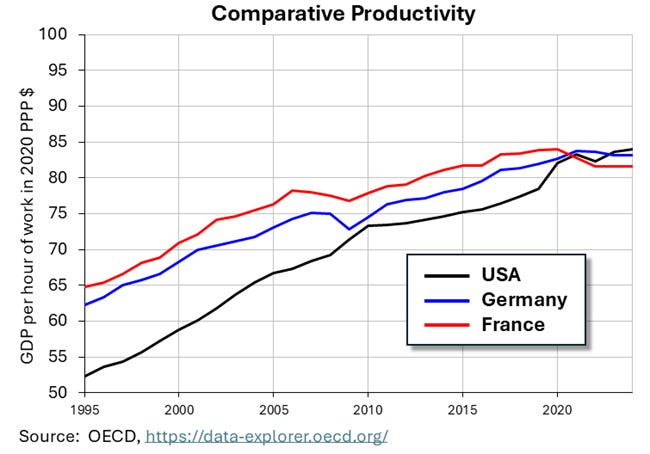
Critics of the European economic model, which include the writers of the new National Security Strategy, often claim that onerous regulation has lowered European productivity and stifled innovation. While there may be some truth to the second part of that claim – Europe has no technology companies to rival the tech giants here in the U.S. – productivity in Europe is about the same as in the United States. It has stalled somewhat in recent years, a fact that Zucman acknowledges, but there are in his view, other important and offsetting considerations.
Europeans, according to his argument, have chosen to reap the benefits of productivity gains differently than Americans – they work fewer hours every year, have less inequality and crime, and in most cases have broader and more affordable access to healthcare. In addition, Europeans have higher life expectancy, fewer gun deaths, lower carbon emissions, and guard their personal data more jealously. Simply put, the European model of capitalism is different than the American model. Perhaps not better in some people’s minds, but certainly different.
We are not alone when it comes to making judgments about the decline of other societies, but it’s a tricky business to engage in. For years, academics and political leaders in China have been arguing that America is in decline, and that their society and economic model is superior. Now we seem to be engaging in the same business with European countries who have historically been our greatest friends and allies. Our new National Security Strategy actually calls for us to interfere in European politics and to support what it calls “patriotic” parties. It almost seems as if our current leadership fears the European model of liberal democracy.
Not content with managing the trajectory of our own country, the current Administration has announced that it should be our goal “to help Europe correct its current trajectory.” Is that really any of our business?

Mural on wall of building, Dresden, 2015