Avoiding the Trap
Without realizing it, I wrote about the Thucydides Trap 21 years ago…

In April 2005 I wrote a column entitled “Do You Speak Chinese” in which I asked whether we were psychologically prepared to deal with a world where we were no longer the pre-eminent economic power. It was not difficult to foresee that China would overtake the U.S. in terms of economic heft sometime early in our children’s lives. The sheer size of China’s population, its rapid growth rate, and expanding interconnectedness with the rest of the world seemed to make that inevitable.
To help make the point, I included this simple chart:
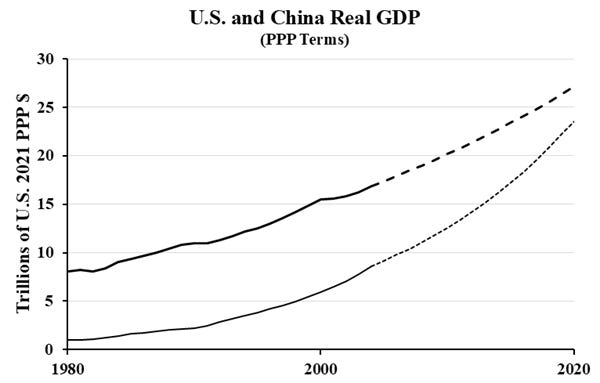
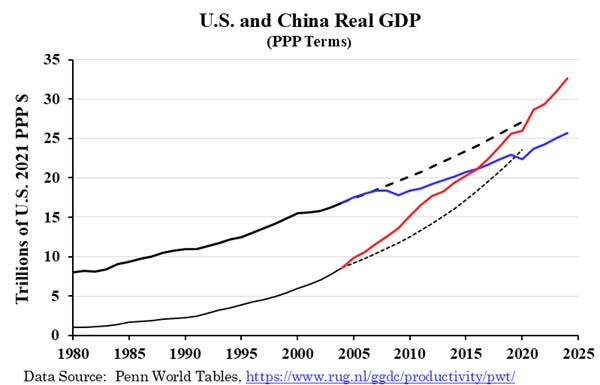
Technical Note: PPP refers to Purchasing Power Parity, a tool that economists use to adjust cross-country comparisons for the local purchasing power of a country’s currency. I described the concept in an earlier post. In 2004, U.S. GDP was about $12.2 trillion and Chinese GDP was ¥16 trillion (yuan). Converting Chinese GDP into dollars at the then-prevailing exchange rate of $1 = ¥8.27 would have meant that Chinese GDP in dollars was $1.9 trillion, implying that the U.S. economy was about six times larger than the Chinese economy. But exchange rates can be misleading indicators of cross-border purchasing power, especially when exchange rates are purposely distorted by government policy. Purchasing Power Parity is a method for correcting that. The PPP method used in my charts uses constant 2021 PPP dollars to control for inflationary effects as well, and implies that the U.S. economy was about twice as big as China’s in 2004.
My extrapolations were crude and, as it turns out, my forecast was too optimistic for the U.S. but not optimistic enough for China. Most economists now consider the Chinese economy to be about 30% larger than the U.S. economy in PPP terms, having surpassed the U.S. sometime around the middle of the last decade. Here is an update of my original chart with extended solid blue and red lines for the U.S. and China respectively:
The question I posed in 2005 was if we were prepared for a world in which we were not the largest economy. Here’s how I put it then:
As the big kid on the economic block, the U.S. will need to come to terms with the new kid. This coming to terms will occur over our lifetimes, and how we deal with China’s increasing economic importance will color our children’s and grandchildren’s lives in ways that we cannot yet imagine.
My point was that American exceptionalism often led us to believe that we were the “indispensable nation” in an international system, and in some respects we were just that in the early post-war era. My concern was for how we, as a nation, would have to adjust if and when that were no longer the case. In my view we could either commit to a truly multilateral international system as our relative position in the world became less dominant, or we could try to maintain our position as the big kid on the block. I thought then, and still think now, that the latter option would be a potentially dangerous and destabilizing one if China became our economic equal and began asserting itself.
I did not explicitly raise the prospect of military confrontation arising out of this scenario as the Greek historian Thucydides had done three millennia earlier when he wrote his history of the Peloponnesian War between Athens and Sparta. In the first book of that history Thucydides had observed that “It was the rise of Athens and the fear that this instilled in Sparta that made war inevitable.”
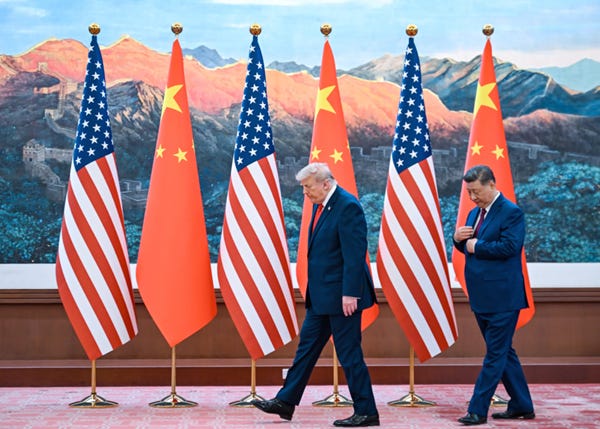
Concerns about just such a scenario were at the center of American international relations scholar Graham Allison’s 2017 book Destined for War – Can America and China Escape Thucydides’s Trap? Allison was concerned that missteps could lead America and China down a similar path to that which Sparta and Athens had taken in Ancient Greece. Many scholars have argued that Allison’s thesis was overly simplistic, and that history neither repeats nor rhymes, but we do now know that Xi Jinping may be taking the historical parallels seriously, because in his opening remarks at the recent summit in Beijing, he said this:
“The world has come to a new crossroads. Can China and the United States transcend the so-called ‘Thucydides Trap’ and forge a new paradigm for major-power relations?”
China is beginning to assert itself in many ways – economically, geopolitically, and militarily – and that assertiveness was on full display during the summit. Some observers have noted that the summit was notable for its lack of substantive agreements, and some have gone as far as characterizing Trump’s position at the summit as one of a supplicant. Xi’s warning to Trump about Taiwan was a very specific and stark example of how he thought conflict could arise.
Aaron Friedberg, Professor of Politics and International Affairs at Princeton and a nonresident senior fellow at the American Enterprise Institute, where he focuses on U.S. – China relations, saw it this way:
“Trump’s position was quite weak, and he played a weak hand poorly.”
He further noted that
“China is aiming to enhance its power with respect to the United States in particular, and eventually to emerge as the dominant player in the international system, and it’s working towards that goal…”
Meanwhile, the U.S. goal seems to be getting the Straight of Hormuz reopened so that the President can move on to the next thing in international affairs, which increasingly looks like Cuba. The Times of India – not a disinterested observer of relationship between the U.S. and China – lamented that instead of any major breakthroughs, the summit “highlighted the widening gap in core interests between the two major powers.”
Perhaps Sparta and Athens experienced a similar “widening gap in core interests” without their leaders realizing it as they stumbled onward towards a tragic war. It was left to the historian to put that frame around the events as they unfolded. Maybe the Thucydides Trap is not a perfect framing for the trajectory of U.S. – China relations. Even so, it may still be worth asking what kind of leadership could best help us navigate such a trap if it is real?
Would we want someone who likes to play the bully, who casually tweets about destroying civilizations, who berates friendly nations and threatens to seize their territory, who cannot imagine another person’s perspective not being a mirror his own, who through it all enriches himself and his family, who dreams of gold-plated ballrooms, underground bunkers, and towering triumphal arches that ultimately celebrate imaginary triumphs?
Or perhaps, instead, we might prefer someone who years from now might be remembered as a statesman who guided his or her country through a difficult passage? Someone who did not erect memorials to him or herself, but lived his or her life in such manner that others wanted to erect memorials to them after they were gone? Someone who was always thinking about the next generation, not the next election. I like to believe that America still has it within itself to allow such people to rise to positions of leadership. But I fear that, at what might be a pivotal moment in our history, we do not have such leaders.